
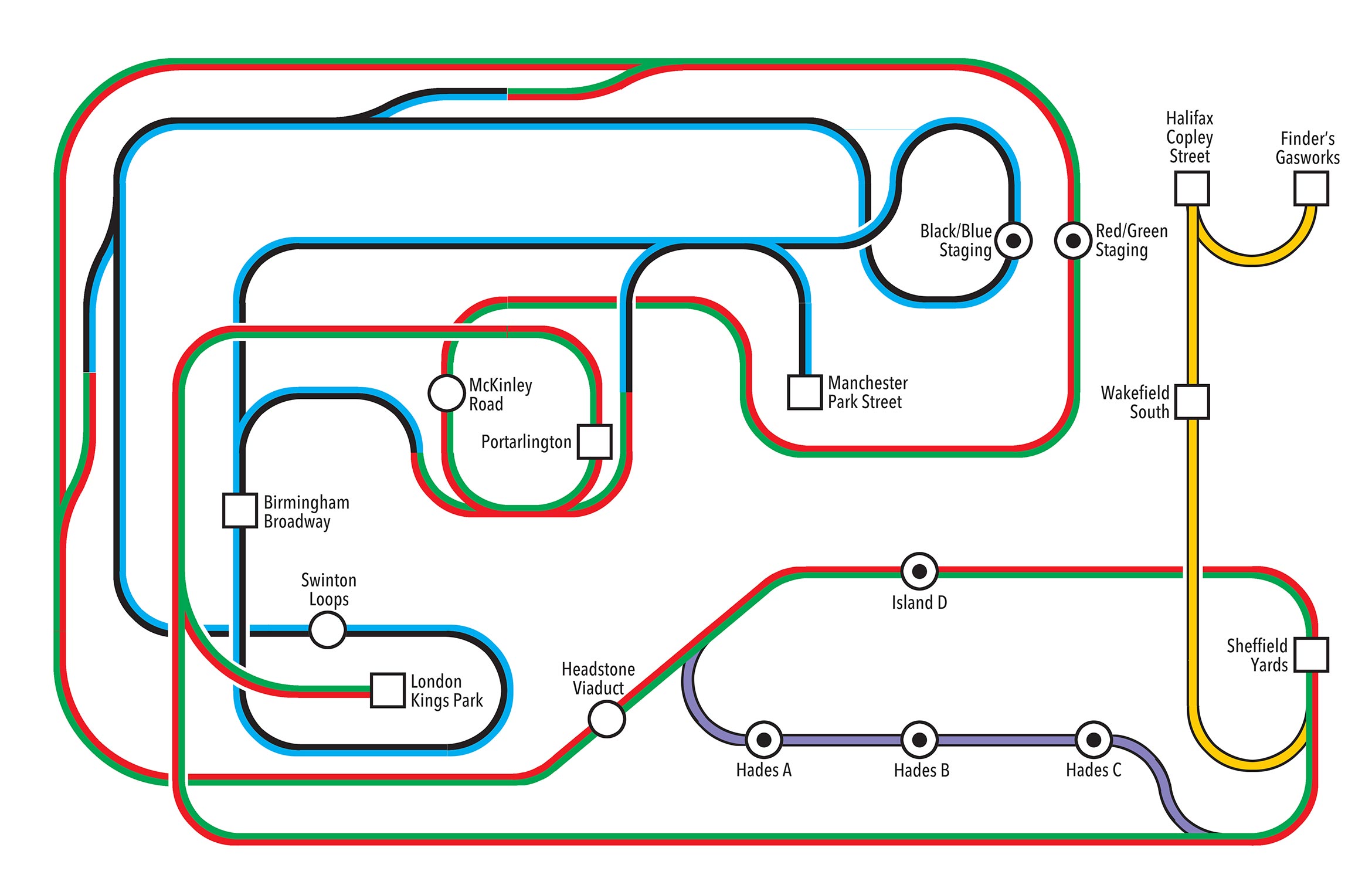
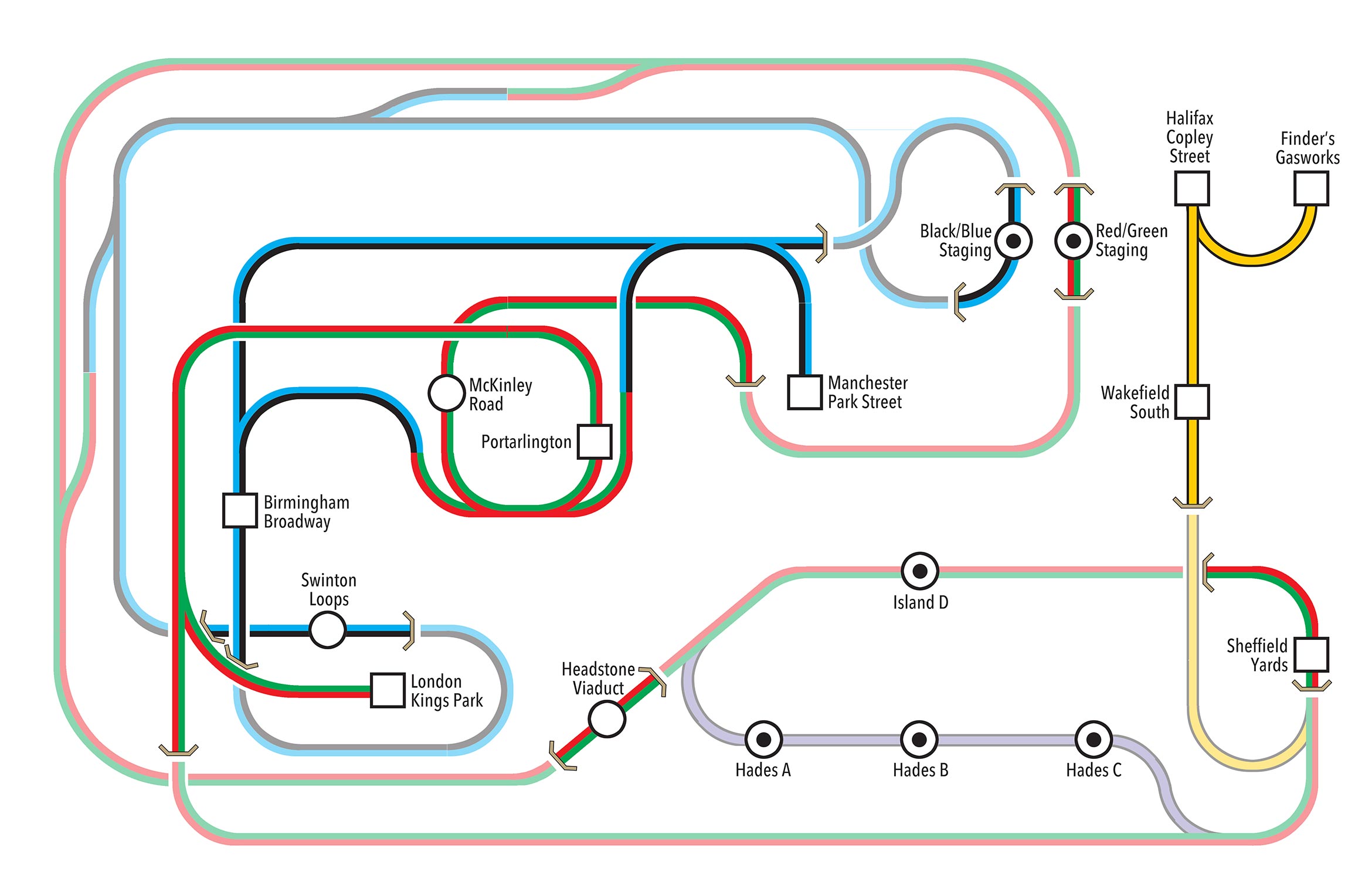
Play with the slider to reveal the tunnels and hidden track. Essentially McKinley is two continuous circuits. One set of lines is the Red/Green Circuit and the other Blue/Black. Off these two circuits are a total of eight locations where we humans manage the railway. The computer looks after the rest. The circles with black dots are storage and staging yards. The plain circles are scenic spots.
The McKinley railway takes up two large rooms, with one hosting the original layout whose roots go back around 25 years, and the second now home to the McKinley extension which has been under construction since 2016.
The extension has hugely increased the scope of the layout; three massive underground storage yards hold a comprehensive roster of locomotives and rolling stock which can be introduced and withdrawn from service to simulate the passing of the years between 1956 and 1975.
At a glance
Era modelled: 1956 - 1975
Layout area: 1,185 square feet (110 square metres)
Track length: 4,000 feet (approx. 1,200 metres)
Track type: Code 100
Points: 450
Track sensors: 985, split between current detectors and infrareds)
RFID antennae: 250
Control: Digitrax DCC, with TrainController software
Rolling stock: 2,750 items, including 446 locomotives
These three levels of storage are topped by two visible levels with three new locations (set in Yorkshire) which complement the original stations at London, Birmingham and Manchester.
Trains can now run between London, the Midlands and the North on two pairs of double-tracked mainlines which appear and disappear above and below ground as they make their way around the layout under the watchful eye of the [insert tactual title of the Fat Controller] at his central operations desk. Trains are run by the TrainController software system in tandem with an extensive Digitrax DCC network.
A major classification yard at Sheffield looks after the layout’s very extensive freight services, and is also the junction for the slightly-more sedate branch line to Wakefield and Halifax.
But while the technology takes care of the running of the main and branch lines, a team of human operators is needed to run the stations themselves. They receive and prepare for departure the many passenger and goods services which run day and night at McKinley. Many of the operators have been McKinley team members for years, and regularly attend Thursday night running sessions.

